
You just had an accident. You're dealing with pain, doctors, insurance adjusters, and paperwork — and suddenly everyone is throwing words at you that you've never heard before.
Negligence. Liability. Damages. Statute of limitations.
These aren't just legal buzzwords. They are the terms that determine whether you get fairly compensated — or shortchanged. At Gonzalez Muñoz Law, we believe you should understand the language of your own case. So we put together this plain-English guide to the terms you'll hear most.
01 — Negligence
What it means: Failure to use reasonable care that causes harm to someone else.
In almost every personal injury case, you must prove the other party was negligent. That means they acted carelessly — and that carelessness caused your injuries. A driver who ran a red light. A property owner who left a wet floor unmarked. A truck company that skipped required maintenance.
Negligence is the foundation. Without it, there is no case. With it, the question becomes: how much harm did it cause, and how much are you owed?
Why it matters to you: If another person's failure to be careful injured you, you likely have a negligence claim. Many victims assume the accident has to be 100% the other person's fault. Under Florida's comparative negligence law, you can still recover even if you were partly responsible.
02 — Liability
What it means: Legal responsibility for injuries, damages, or losses.
When someone is liable, they are legally required to compensate you for the harm they caused. Liability can fall on a single person — or on multiple parties at once. In a truck accident, for example, liability might be shared between the driver, the trucking company, and the vehicle's manufacturer.
Why it matters to you: Insurance companies spend enormous resources trying to minimize or shift liability. "Their client was only 10% at fault." "The road conditions were a factor." "The victim shares responsibility." Establishing clear liability is one of the most important things an experienced attorney does for you.
03 — Damages
What it means: The money you may recover for losses caused by the accident.
Damages fall into two main categories:
- Economic damages: Medical bills, future medical costs, lost wages, loss of earning capacity, property damage. These are documented, concrete losses.
- Non-economic damages: Pain and suffering, emotional distress, loss of enjoyment of life, loss of consortium. These are real — but harder to put a number on, which is why insurance companies fight them hardest.
Why it matters to you: The initial offer from an insurance company almost never accounts for the full scope of your damages — especially future costs and non-economic losses. Gonzalez Muñoz Law has recovered over $100 million for injury victims precisely because we document and argue for the complete picture.
04 — Settlement
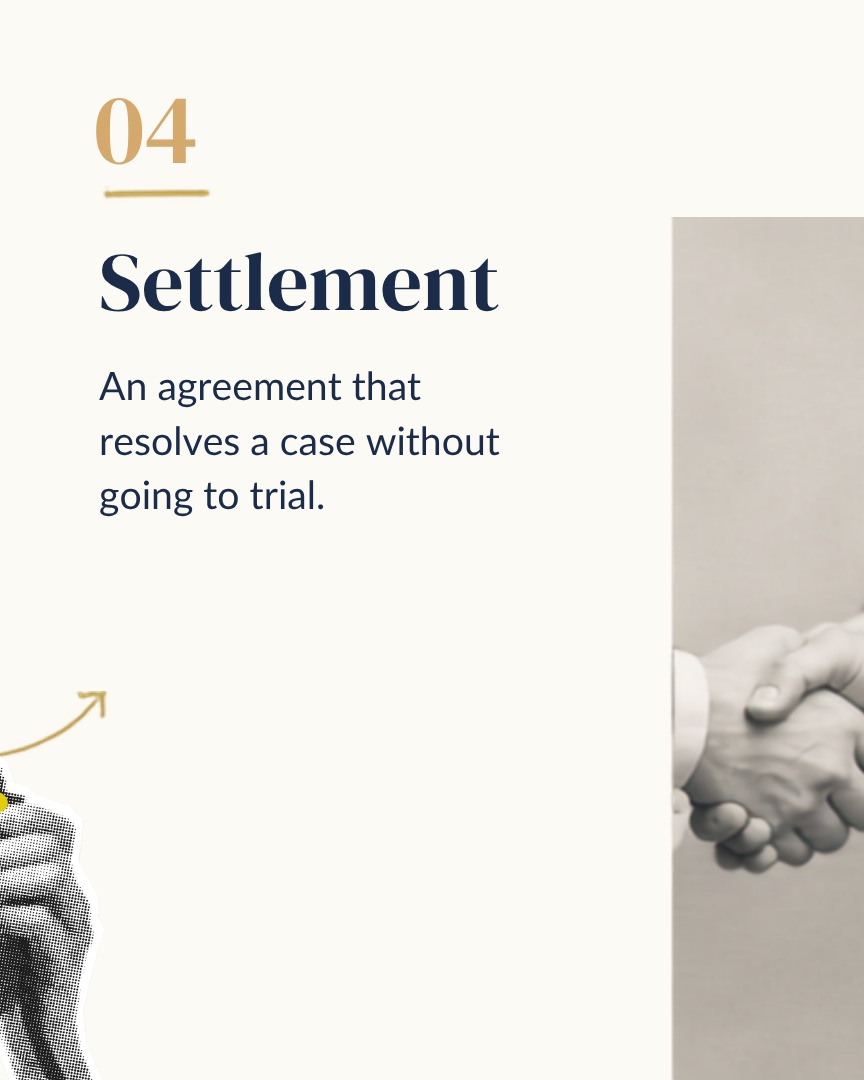
What it means: An agreement between parties that resolves a case without going to trial.
The majority of personal injury cases in Florida settle before reaching a courtroom. A settlement means the defendant (or their insurance company) agrees to pay a specific amount, and you agree to release all future claims related to the injury.
Why it matters to you: Settling isn't giving up — it's often the best outcome. But the timing and amount of a settlement matter enormously. Settling too early — before you know the full extent of your injuries — can leave you responsible for future medical costs that weren't factored into the agreement. A good attorney knows when to settle and when to push.
05 — Statute of Limitations
What it means: The legal deadline for filing a lawsuit.
In Florida, you generally have 2 years from the date of your injury to file a personal injury claim. This deadline is strict. Miss it, and you typically lose your right to any compensation — regardless of how strong your case is.
Why it matters to you: Two years sounds like a lot of time. It isn't. Evidence disappears. Witnesses forget. Medical records get harder to obtain. Insurance companies count on injury victims waiting too long, then losing their legal options. The earlier you consult with an attorney, the more you protect your claim.
Bonus Terms Worth Knowing
Contingency Fee — The fee arrangement where you pay nothing unless your attorney wins. At Gonzalez Muñoz Law, you never pay upfront. Our fee comes only from the recovery we obtain for you.
PIP (Personal Injury Protection) — Florida's no-fault coverage that pays your medical bills and a portion of lost wages after an accident, regardless of fault — up to your policy limit. You must seek medical treatment within 14 days of the accident to qualify.
Pain and Suffering — Compensation for physical pain, emotional distress, and reduced quality of life. There's no fixed formula for calculating this, which is why it's often undervalued by insurance companies — and why representation matters.
Comparative Negligence — Florida law that allows you to recover damages even if you were partially at fault for an accident. Your recovery is reduced by your percentage of fault. If you were 20% at fault and your damages are $100,000, you can still recover $80,000.
Download This Guide
Use the button below to download a clean, printable PDF version of this cheat sheet — 8 terms, plain English, one page. Keep it handy, share it with someone who needs it, or reference it as your case progresses.
Have Questions About Your Case?
You don't need to be a lawyer to get a fair result — you just need one on your side. Gonzalez Muñoz Law offers free consultations in English, Spanish, Haitian Creole, and Russian. We handle every case on contingency: you pay nothing unless we win.
Call 305-770-6666 or message us on WhatsApp — we're available 24/7.